
Trench and excavation safety in BC: the basics
A plain-language starting point for owners and builders. It is not legal advice; the OHS Regulation and WorkSafeBC are the authority.
Locate before you dig
Section 20.79 of the OHS Regulation: before excavating or drilling with powered tools and equipment, the location of all underground utility services in the area must be accurately determined. Work near a utility must follow the owner’s requirements, and pointed tools must not be used to probe for petroleum or electrical utilities.
WorkSafeBC: contacting BC 1 Call is the best way to find out what is buried in your dig site.
BC 1 Call members require 3 working days’ notice (excluding weekends and holidays); excavation must start within 14 calendar days of the request, and the ticket is then valid for 30 calendar days. Online (E-ticket) locate requests are free.
What counts as a trench
Under Part 20, a trench is an excavation less than 3.7 m (12 ft) wide at the bottom, over 1.2 m (4 ft) deep, and of any length.
Sloping, benching and shoring
Section 20.81: before a worker enters any excavation over 1.2 m (4 ft) deep, or comes closer to the side than the excavation’s depth, the sides must be sloped, benched or supported — as a qualified registered professional or engineer specifies, to suit soil conditions, or with trench boxes, shoring cages or other effective means.
Section 20.78: a qualified registered professional’s written instructions are required if the excavation is more than 6 m (20 ft) deep, a structure is adjacent, vibration or hydrostatic pressure could cause hazardous ground movement, or the ground slopes away steeper than 3:1. Support structures need a professional engineer’s written instructions.
Notice of Project
WorkSafeBC must receive a Notice of Project at least 24 hours before work starts when, among other triggers, a worker may enter a trench over 30 m long or an excavation (other than a trench) over 1.2 m deep, or the project builds an earth or water retaining structure over 3 m high.
Trench boxes in practice
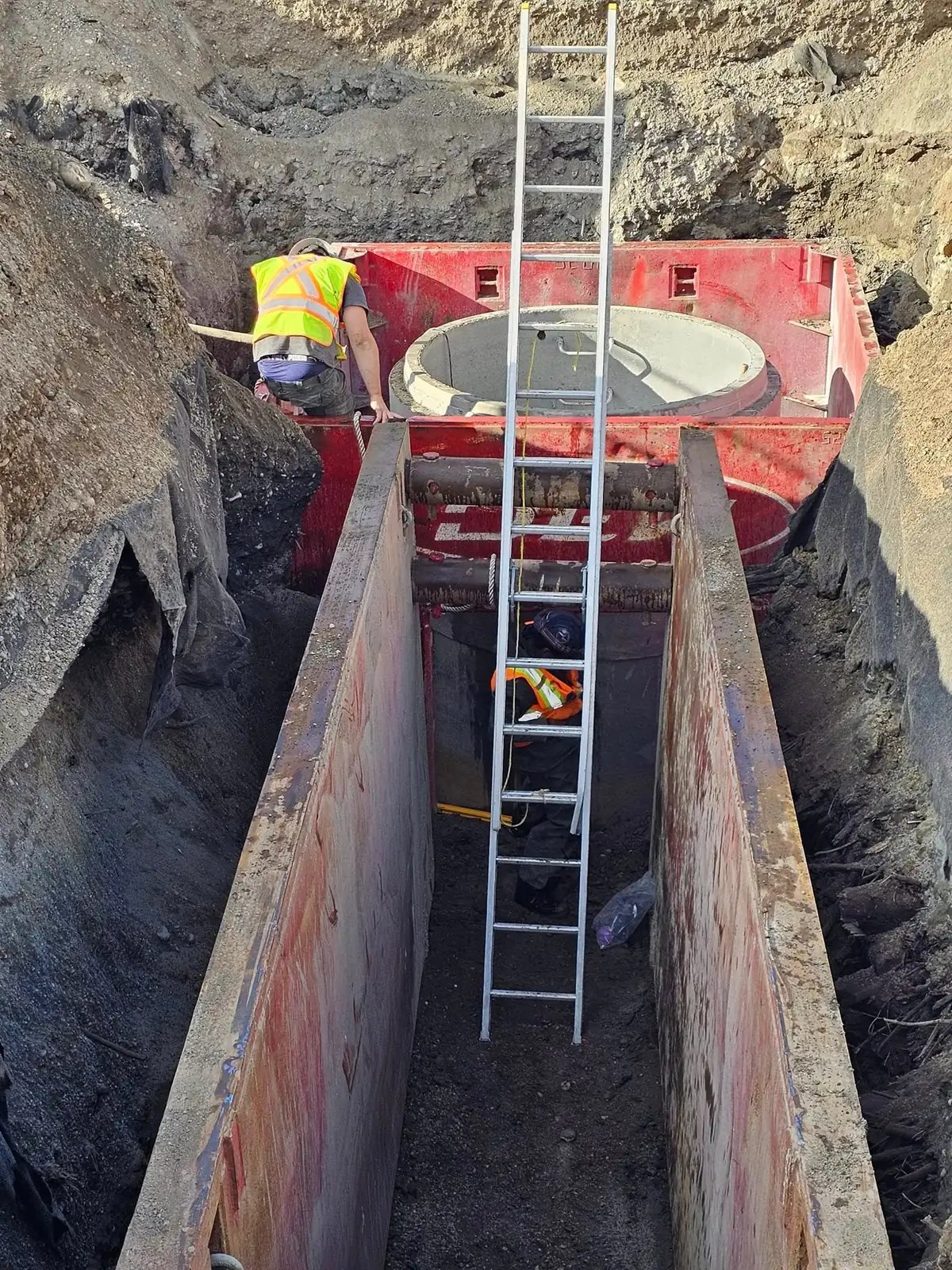
Where sloping the walls back is not practical — next to a road, a building or other services — crews work inside a trench box or shoring system. The PCE utility projects shown on this site were done that way, and PCE operators hold confined space entry certification.
Checked October 2026 against the sources linked on this page. Rules change, so confirm with the authority before work starts. General information only, not engineering or legal advice.
Got a big job coming up?
Tell us where it is, what needs to come out of the ground and when. We’ll tell you how we would do it.